Some Thoughts on AI Writing
Living in San Francisco in 2026, and in my tech-adjacent line of work, I encounter a lot of discussion about AI writing. Here are some of my loosely connected thoughts on the subject:
- Every part of the writing process is thinking, from making observations to doing research/discovering sources to brainstorming; to the active drafting and revising process; to the editing and proofreading processes; and to getting feedback from beings with the ability to think, and with experiences, feelings, and intention behind what they’re saying. These are all active processes that require thought, reflection, problem-solving, deliberation, dialogue/interaction, and that often turn up unexpected insights and new bits of information along the way. These processes, when actively participated in, teased out, and worked through, beget more thinking, more creativity, more ideation. Outsourcing any part of this is outsourcing thinking you would’ve benefitted from doing yourself.
- I had the above thought after reading this article on Substack. I enjoyed reading it, it was really cool learning about how the author’s perspective on using AI as a writing tool has shifted over time, and I look forward to reading more of her posts!
- My disagreement was with the author’s compartmentalization of the writing process into steps where, in her view, using an LLM is more or less risky. (see below)
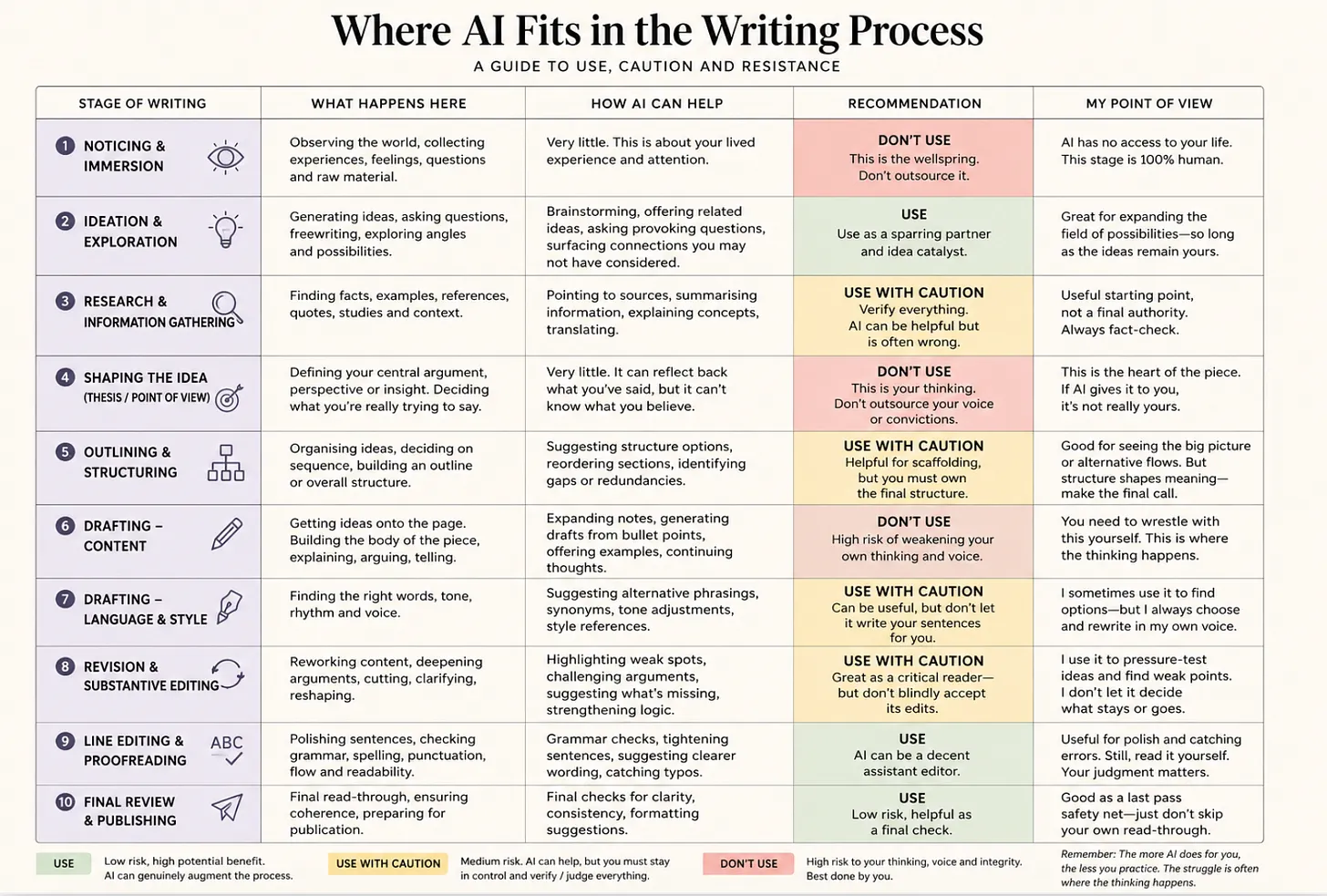
- For step #2 in the above chart, I think you would be much better served using humans*, or their work*, as “sparring partner[s]” and “idea catalyst[s].” While it’s possible to use an LLM for these things, you would likely get much deeper, richer insights from the former sources. Moreover, when you’re “talking” to an LLM, its output is heavily influenced by your input, so you would be much more likely to encounter beneficial, unexpected pushback, unanticipated insights, brand new ideas, and so on from words not so heavily based on your current mental state, current lines of thinking, etc.
- *It goes without saying, this depends on the quality of the human thinker(s) you’re using as a “sparring partner.” However, I would kindly suggest that if you find talking to an LLM to be more enlightening than talking to the people you know or reading, it may be a good idea to reconsider who you talk to and what you read. There have been few things more inspiring, impactful, and thought-provoking to me throughout my life than some of the books, papers, articles, and other written works I’ve read and become fully enrapt by, as well as so many of the discussions I’ve had with my husband and close friends (all of whom I could only hope to be as thoughtful as one day!).
- To me, using an LLM as something to bounce ideas off of is perhaps not the same as, but seems very close to, having arguments in your own head. I guess it can be fruitful sometimes, but at the end of the day, it’s impossible for any one of us to see completely outside of our own perspective. To even approach this, it is much more effective to seek the perspectives of autonomous, thinking beings not so heavily influenced by ourselves.
- For steps #9 & #10, if you’re using modern word processing software, grammar checks and typo catching will have been active from the moment you started writing, so there’s probably no need to use an additional AI for these things. When it comes to things like “tightening sentences,” “suggesting clearer wording,” and “final checks for clarity, consistency, formatting suggestions,” however, those are all processes that are best engaged in actively and by using your own brain. Doing so is the only thing that will help you become a better writer, and thinker, with repeated practice.
- Basically, my disagreement is that any benefit you could get from doing these things with an LLM would be far greater in magnitude, and have more positive, long-term consequences, if you actively engaged in the process of doing them yourself.
- Outsourcing your thinking–not actively thinking–makes you, over time:
- Less creative
- Less intelligent
- I’m speaking from personal experience here (see my last post)!
- I think it’s possible to still find meaning in a work you’ve misinterpreted or for which you disagree with the creator’s intentions, and I think, at least in theory, this can be extended to instances when there is a lack of “intention” behind the work (as is the case when it comes to AI writing, to a greater or lesser degree). Inherently “meaningless,” “insightless” things (e.g. the certain way a leaf falls, the certain way a cliff face looks) can still inspire at times. That being said, at least so far, I have yet to knowingly encounter a work of AI writing I thought was meaningful or worthwhile to have read, or from which I’ve taken away anything useful. I think this is largely a consequence of bullet points #2 & #5.
- At the end of the day, you don’t need to use AI to write if you either know what you’re talking about or have something truly substantial to convey. Because, at a certain level of detail, specificity, and personalization, the prompt you would be giving to an LLM would just be you actually writing the thing in the first place!
- I wrote this blog post in bullet point form because it felt like the most natural, effective way to organize my thoughts. I could have, hypothetically, thrown these bullet points at an LLM and asked it to “format these as a cohesive, paragraph-form blog post in my unique tone/voice” or something to that effect. But what would the point have been? Everything I wanted to say I have already said. It already makes sense to me and I’ve already expressed myself to the extent I’ve wanted to in the exact way that I wanted to. And I’ve literally just been writing down and re-organizing my thoughts as they come to me! I thought of this sub-point after writing bullet point #5 and all of its sub-bullet points, and decided it made more sense to put here. These are the sorts of insights and writing-skill-building-exercises you would miss if you outsourced revising, organizing, editing, etc. to an LLM!
- From my observations, the types of people who use LLMs in their writing process (insofar as it’s obvious to me) tend to be as follows:
- People who don’t have much to communicate, but want to seem like they do; people who have made a habit of outsourcing their thinking, for whatever reason.
- Advice: Focus on developing worthwhile, substantive thoughts to share (by learning, researching, observing, doing, experiencing, experimenting, talking with other people, etc.) in the first place. It seems to me a strong motivation for posting AI writing on social media is to try to get attention without putting much effort in, but most people–and probably anyone from whose attention you’d genuinely benefit–can tell immediately that it’s AI, and also, by and large, seem to consider it a huge turnoff.
- People who aren’t confident in their ability to write.
- Advice: You’ll never get better unless you start and keep practicing. You’ll just get worse and worse and rely on LLMs more and more if you keep not practicing. There are pretty much endless ways to express yourself through writing, and you don’t have to start with some grand, ambitious project. It doesn’t have to be good and it doesn’t have to be a full project. You can get better at expressing yourself by conversing with more people (or more often), trying to improve your clarity via text message, just free-writing your thoughts then either refining them as you go or reflecting on what you wrote later on (or doing so with a friend), reading the work of people whose writing you admire and writing about why you think it’s “good” (perhaps in comparison to yours), and through an infinite number of other ways too.
- People who just don’t care that much about the writing they’re doing–for example, perhaps it’s for some tedious, dubious-in-value work-related purpose.
- Advice: I actually think this might be the one “valid” (in my opinion) use case for LLM writing right now. If you’ve been tasked with, say, writing website copy for SEO, and it’s likely not going to be read by human beings, and your time would be better spent doing something else, and you’re already very busy at work, and so on, it honestly probably makes sense to use an LLM. Whether there’s any point to this sort of work in a broader sense is a separate matter.
- People who don’t have much to communicate, but want to seem like they do; people who have made a habit of outsourcing their thinking, for whatever reason.
- Basically, with all of this, I mean to say I think there are almost no circumstances in which you should use AI to write, because I think there are almost no circumstances in which I think you should outsource your thinking. If you frequently find yourself in circumstances where you feel the need to outsource your thinking, you should either practice thinking more or change your circumstances, if at all possible.